

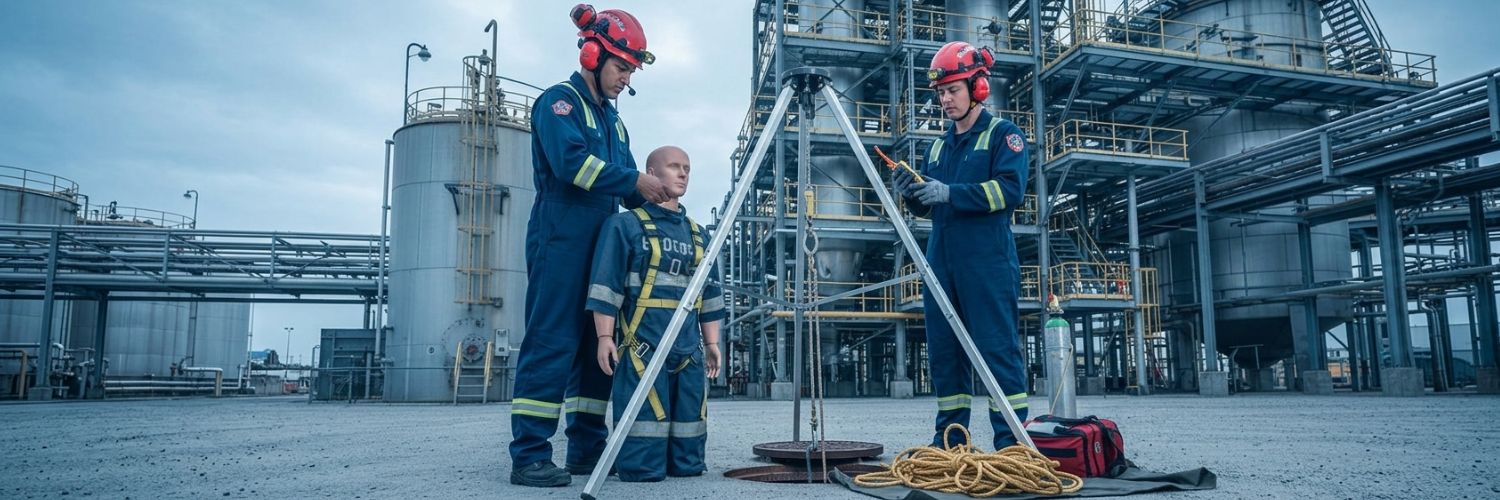
A permit-required confined space (PRCS) contains hazards that pose immediate risks to life. Federal law mandates a “prompt” rescue response to prevent permanent injury or death. Professional standards require continuous monitoring and the use of certified technicians to manage atmospheric, engulfment, and entrapment risks.
Understanding Permit-Required Confined Space Rescue Standards
OSHA 1910.146 defines a permit-required confined space (PRCS) as an area with known safety hazards. These spaces may contain atmospheric, engulfment, or entrapment risks. Employers must provide a “prompt” rescue response for any worker entering these zones. Time is the most critical factor in a crisis. Oxygen deprivation causes permanent brain damage within a four-minute window. This Confined Space Rescue Overview outlines the technical complexity involved in these high-stakes operations. Professional confined space rescue teams mitigate these risks through clinical precision and rapid deployment.
The Regulatory Framework for Industrial Safety
Federal OSHA establishes the baseline for industrial safety protocols. However, state-specific regulations, such as Cal/OSHA, often require more stringent safety measures. A “qualified” rescue technician must complete rigorous training and demonstrate proficiency annually. Failure to meet these standards leads to heavy fines and significant legal liability. Our approach ensures full compliance with all governing bodies. We prioritize technical mastery to protect your personnel and your reputation.
IDLH Environments and Atmospheric Monitoring
Immediately Dangerous to Life or Health (IDLH) environments present an instant threat to workers. These areas require continuous atmospheric monitoring to detect toxic gases or oxygen deficiency. The permit writer documents every safety parameter before authorizing entry. This documentation creates a clinical record of the environment’s stability. If sensors detect a shift in air quality, the team initiates an immediate extraction. We utilize advanced telemetry to maintain a clear path to safety. Methodical monitoring transforms a high-risk environment into a controlled workspace.
Entry vs. Non-Entry Rescue: Strategic Decision Making
Effective confined space rescue requires a clinical risk assessment. Safety protocols follow a strict hierarchy to protect lives. Self-rescue remains the primary objective for any entrant. If self-rescue fails, teams must immediately prioritize non-entry methods. This approach minimizes human exposure to hazardous atmospheres. Regulators prefer non-entry because it protects the rescue team. Untrained personnel often attempt spontaneous, emotional rescues. These attempts frequently result in multiple fatalities within minutes. Data show that 60% of confined-space deaths involve “would-be” rescuers. Consult the Cal/OSHA Guide to Confined Space Rescue for detailed hierarchy standards. A clear path forward requires objective, data-driven decision-making.
Non-Entry Rescue Protocols and Limitations
Non-entry rescue utilizes external mechanical retrieval systems. Teams deploy industrial-grade tripods, winches, and davit arms. Entrants wear wristlets or chest harnesses for vertical extraction. These systems provide a secure, direct path to safety. However, physical limitations often exist within industrial vessels. Obstructions, such as internal piping or tight bends, prevent mechanical retrieval. If the retrieval line snags, non-entry becomes impossible. A clinical evaluation must identify these physical barriers before entry occurs. Professionals must verify the line of sight for all retrieval cables to ensure a smooth recovery.
Technical Entry Rescue Procedures
A technical entry is necessary when mechanical retrieval fails. This process follows a precise, clinical sequence of mobilization. Mobilization begins with continuous atmospheric monitoring and ventilation. Rescuers don SCBA or supplied-air respirators for maximum protection. They enter the space to stabilize the patient’s medical condition. Patient packaging requires specialized litters or Kendrick Extrication Devices. Complex configurations demand advanced high-angle rope techniques. Executing these maneuvers safely requires certified rescue teams. Professional intervention ensures the victim and the rescuer remain secure. This methodical approach eliminates the chaos of an emergency confined space rescue operation.
Essential Hardware and Technology for Technical Rescue
Precision hardware is key to the success of a confined space rescue. Professionals utilize an extensive inventory of “Life Safety” rated equipment. Every carabiner, pulley, and rope must meet strict NFPA 1983 standards. Mechanical advantage systems reduce physical strain during victim extraction. Ratios like 3:1, 4:1, or 5:1 allow a single rescuer to lift heavy loads effectively. These systems provide critical leverage within vertical industrial shafts and silos. Technical competence requires total mastery of these mechanical configurations.
In 2026, atmospheric monitoring technology has reached new heights of precision. Modern sensors utilize cloud-integrated PID (Photoionization Detection) for real-time gas tracking. Wireless mesh networks now transmit data through thick steel barriers and concrete floors. This ensures the entry team’s continuous safety via remote telemetry. Intrinsically safe lighting prevents accidental ignition in volatile, explosive environments. Communication gear must remain clear to ensure seamless team coordination. We leave nothing to chance when lives are on the line.
Respiratory Protection and Ventilation Systems
Self-Contained Breathing Apparatus (SCBA) offers maximum mobility for short-duration interventions. Supplied Air Respirators (SAR) provide extended air supplies for deep, complex entries. Both systems require rigorous, documented maintenance. Positive-pressure ventilation clears toxic vapors from deep vaults before personnel enter. Rescuers must perform daily calibrations and monthly hydrostatic testing on all life-critical gear. Reliability remains the only acceptable standard in our laboratory-grade approach to safety.
Patient Packaging and Extrication Tools
Specialized SKED stretchers allow for smooth movement through narrow apertures. These tools secure the patient during difficult vertical or horizontal transitions. High-angle rope systems manage weight safely within complex industrial structures. Hardware redundancy is mandatory for every confined space rescue operation. Every primary line requires a secondary, independent safety belay. This clinical approach to equipment ensures a predictable and successful outcome in high-stakes environments. We prioritize technical precision over speed every time.
Developing and Executing a Site-Specific Rescue Plan (SSRP)
OSHA mandates a Site-Specific Rescue Plan (SSRP) for every permit-required entry. Generic plans fail because they ignore unique environmental variables. A comprehensive SSRP identifies specific access points, atmospheric hazards, and mechanical risks. It maps the exact response sequence for a confined space rescue. We integrate attendant safety watches to monitor every entry point. These specialists ensure constant communication with entrants. Before work begins, teams conduct a mandatory pre-entry briefing. This meeting confirms that every authorized entrant understands the rescue protocols and evacuation routes.
The Role of the Safety Professional
Safety roles require distinct focus and specialized training. The Hole Watcher monitors the entrance to the space and tracks personnel. The Fire Watch focuses specifically on hot work hazards and ignition sources. Our safety professionals mitigate risk through relentless observation. They maintain the absolute authority to terminate entry if conditions change. This oversight prevents minor incidents from becoming fatal accidents. Technical competence at the portal is your first line of defense.
Simulation and Mock Rescue Drills
Compliance requires annual practice rescues for all entry teams. Site-specific drills reveal logistical bottlenecks in the response chain. We utilize “blind” drills to test true team readiness. These simulations identify equipment gaps and communication delays. Realistic practice ensures a clinical response during an actual confined space rescue. Teams must demonstrate proficiency in victim packaging and extraction techniques. Regular testing transforms a written plan into an actionable survival strategy.
The Advantage of Professional Industrial Standby Teams
Industrial environments demand absolute technical competence. We view safety through a clinical lens. Our standby teams provide a “ready-state” equivalent to a guaranteed recovery. We eliminate the uncertainty of emergency response through meticulous preparation. Outsourcing to specialized firms lowers your internal overhead. It also transfers the burden of equipment maintenance to our experts. The DCS Rescue division leverages 50 years of combined field experience. We remain unfazed by complex infrastructure or hazardous environments.
Why Municipal Services Are Not a Standby Solution
Municipal fire departments face significant logistical hurdles. They cannot meet the critical 4-minute rule for oxygen-deficient environments. Most stations sit miles away from your facility. External crews lack familiarity with your specific piping and hazards. Legally, listing “911” as your primary confined space rescue plan is often insufficient. OSHA mandates a prompt response that municipal services rarely guarantee. Relying on public services increases your legal and operational risk. Our teams remain on-site and ready to deploy in seconds.
Partnering with DCS Rescue for Project Success
We integrate directly into your petrochemical or construction workflows. Our technicians operate like a high-level field laboratory. We follow a logical, sequential process to identify risks before they escalate. This proactive staffing prevents project delays and reduces insurance premiums. We offer a clear path forward for project managers facing high-risk entries. Our presence provides a psychological safety net for your entire crew. We apply a clinical approach to every confined space rescue scenario to ensure a successful outcome.
Frequently Asked Questions
What are the three categories of confined space rescue?
Confined space rescue involves three distinct methodologies: self-rescue, non-entry rescue, and entry rescue. Self-rescue allows the entrant to exit independently upon sensing a hazard. Non-entry rescue utilizes external retrieval lines and mechanical winches to extract personnel. Entry rescue requires highly trained technicians to physically enter the hazardous environment. Each category demands specific technical equipment and an immediate tactical response to ensure personnel safety.
Is the local fire department considered a valid rescue team by OSHA?
A local fire department is not automatically a valid confined space rescue team. OSHA requires employers to evaluate a team’s specific proficiency and response time before work begins. Many municipal departments lack the specialized equipment or industrial training required for complex sites. You must verify their capability and availability through a formal written agreement and site-specific orientation to remain compliant.
What is the 4-minute rule in confined space rescue operations?
The 4-minute rule dictates the survival window during oxygen-deficient emergencies. Irreversible brain damage typically begins after four minutes of respiratory arrest. This clinical reality necessitates an immediate, pre-planned response. Rescue teams must arrive and initiate life-saving measures within this critical timeframe. Delayed intervention often transforms a rescue mission into a recovery operation. Technical precision and speed save lives during these crises.
Who is responsible for providing rescue services during a permit entry?
The host employer is primarily responsible for providing rescue services. They must ensure a qualified team remains available during all permit-required entries. This obligation includes providing all necessary safety equipment and specialized technical training. Employers may use an internal team or contract a third-party professional service. Failure to secure these services constitutes a significant regulatory violation and endangers workers.
What is the difference between a hole watcher and a rescue technician?
A hole watcher, or attendant, monitors the entry point and maintains constant communication. They never enter the space during an emergency. A rescue technician possesses the advanced training required for physical entry and victim extraction. Technicians manage complex rigging, atmospheric monitoring, and medical stabilization. While both roles are vital, their technical scopes and physical responsibilities differ significantly in a crisis.
How often must a confined space rescue team perform practice drills?
OSHA mandates that rescue teams perform practice drills at least once every 12 months. These simulations must utilize manikins or actual personnel in representative spaces. Regular training ensures that technicians maintain proficiency in rigging and extraction techniques. Frequent drills identify equipment failures and refine communication protocols. Consistent practice transforms theoretical knowledge into reliable, clinical execution during real-world industrial emergencies.
What equipment is mandatory for a permit-required confined space entry?
Mandatory equipment includes calibrated multi-gas monitors for continuous atmospheric testing. Entrants must wear full-body harnesses attached to mechanical retrieval systems. Communication devices, such as intrinsically safe radios, ensure constant contact with the attendant. Proper lighting and personal protective equipment are also essential. This technical gear creates a secure environment for every confined space rescue operation and minimizes environmental risks.
Can one person serve as both the attendant and the rescuer?
No, one person cannot fulfill both roles simultaneously. The attendant must remain outside the space to monitor hazards and summon help. Entry rescue requires a dedicated team of at least two people to perform the extraction safely. Combining these roles compromises the safety of both the entrant and the supervisor. Strict role separation provides a redundant, reliable safety net for all personnel.
Securing Industrial Safety Through Technical Precision
Compliance requires a precise understanding of permit-required standards and strategic entry decisions. Effective confined space rescue operations rely on specialized hardware and rigorous Site-Specific Rescue Plans (SSRP). These protocols ensure professional teams manage technical complexities with clinical precision. Mitigating industrial risk demands more than just equipment; it requires a systematic approach to life safety. A reliable standby team provides the expertise necessary to navigate high-stress environments calmly. By prioritizing certified technical proficiency, you establish a clear path toward operational security and worker protection.
DCS Rescue provides the clinical expertise and technical hardware necessary to protect your workforce in the most challenging industrial environments. As a division of Ancon, our team brings over 50 years of combined technical rescue experience to your facility. We deploy certified technicians equipped with specialized hardware to manage every contingency. Our proven methodology ensures that your personnel remain secure under our expert watch. Contact DCS Rescue today to secure your certified standby team. We stand ready to provide the professional intervention your project requires.